What Is NIL and Why Is It Taking Over College Athletics?
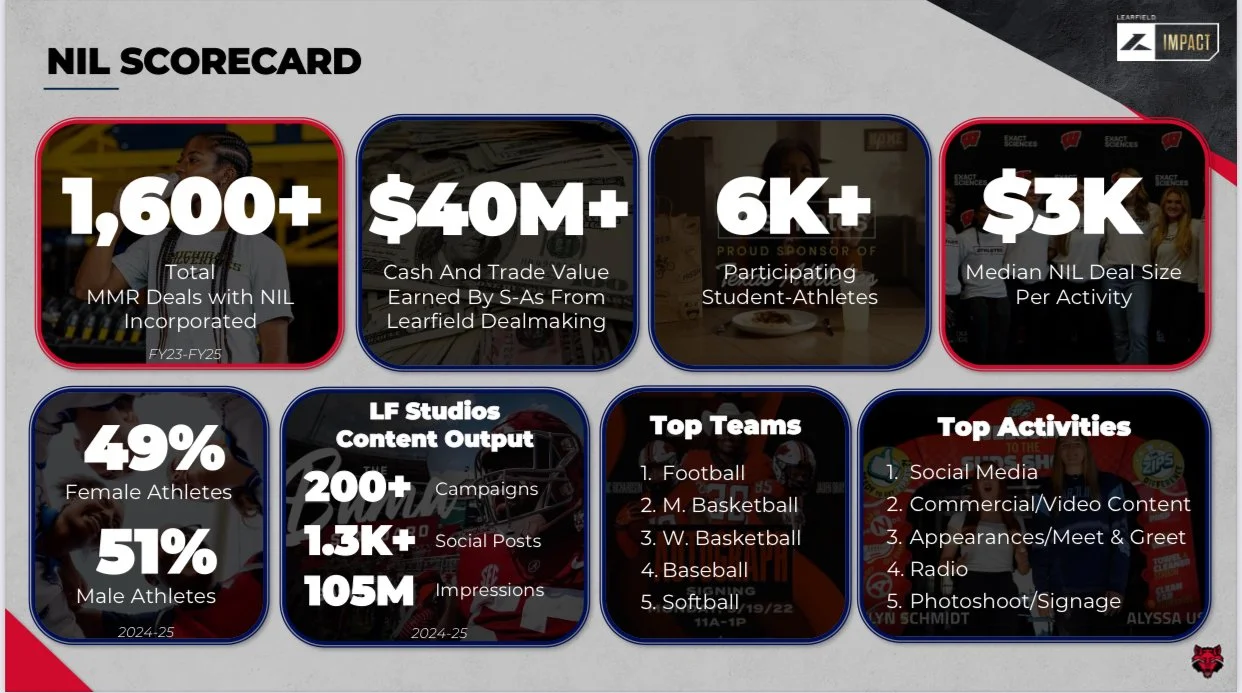
Graphic by Learfield Impact
Lexi Cantrell
Sept. 17 2025
Not long ago, simply accepting a free dinner might have resulted in a collegiate athlete losing their eligibility. Thanks to NIL, the rule that is changing college athletes, including Arch Manning and Carson Beck are now valued at millions of dollars.
What is NIL?
NIL stands for name, image, and likeness. Athletes can manage the use of their name, image, and likeness thanks to NIL. College athletes may receive payment directly from their school or through third-party sources,including campaigns, sponsorships, and brand deals.
Prior to the implementation of NIL, student-athletes were not allowed to make money off of their reputation. The question of whether it was appropriate for colleges and other companies to use student athletes' appearances to develop their brands began to spark debate.
The NCAA established NIL policies on July 1, 2021, permitting student-athletes to participate in NIL-related endorsements in any sport.
How Did NIL Start?
Before 2021, student-athletes battled for their name, image, and likeness, which prompted important discussions about paying students for their dedication.
In several legal instances, the NCAA was found to have violated the Sherman Antitrust Act by limiting or outright forbidding student-athletes from receiving compensation for using their NIL. This prohibition, along with restrictions on education-related benefits, was found to be unlawful and deprived athletes of profits for their labor.
One well-known litigation was O'Bannon v. NCAA, which was brought by former UCLA basketball player Ed O'Bannon, who opposed the NCAA's exploitation of the players' pictures and likenesses for profit. Without his consent, O'Bannon's image from the 1995 national championship squad was used in NCAA Basketball 09, the video game from EA Sports.
The NCAA was found to have violated the Sherman Antitrust Act in the trial's verdict. Judge Claudia Wilken mandated that colleges grant athletes full cost-of-attendance scholarships, which would cover living expenses that were not previously covered by NCAA scholarships. In addition, the NCAA was mandated to reimburse the plaintiffs for $42.2 million in charges.
After years of pressure from the public, athletes, and the courts, NIL laws were finally passed to grant athletes the right to control their name, image, and likeness.
How Does NIL Work?
NIL is currently defined in two ways. The first definition, which most people are familiar with, states that NIL is the exchange of goods and services between the brand and the student athlete through market value. Popularity, social media reach, athletic achievement, and the kind of NIL deal are some of the criteria that determine how much student athletes get paid through various sorts of content, including campaigns, photoshoots, and social media material.
The pay-for-play component is the second definition. Paying players directly to attend a university is known as pay-for-play. Initially, these athletes were being funded by organizations created by donors. Universities are now paying players to attend their school as a result of the recent House v. NCAA settlement.
Paying student athletes up to $20.5 million a year is permitted for schools that choose to join the House settlement. While each university chooses how much of the $20.5 million it wants to spend on programs and players, Learfield data shows that 75% of the money is spent on football player salaries. Basketball receives roughly 10–15% of the total, with the remainder being split among other sports according to each university's priorities.
Who “Runs” NIL?
NIL includes a lot of behind-the-scenes work, but sports fans usually only see the content that the athletes create. Numerous businesses in the NIL sector assist universities in negotiating deals and navigating the NIL landscape.
Learfield plans and manages NIL for 145 universities across the country. In collegiate athletics, Learfield is the top media and technology company. For sports, brands, and entertainment properties, their goal is to increase income, growth, brand exposure, and fan engagement.
Competing organizaitons in the sports marketing business include JMI Sports and Playfly Sports.
Executive Vice President for NIL Growth and Development at Learfield, Solly Fulp, shares details on how Learfield handles NIL at each school it collaborates with.
“Learfield owns the commercial IP rights for the university’s marks and logos for brands,” Fulp said. “Learfield also has revenue-sharing agreements. Hypothetically, if a brand wanted to use a university’s marks or logos, they would have to go through us.”
If a university's marks or logos are employed in any commercial activity, Learfield is present. However, if a student athlete wanted to pursue a NIL deal, where none of their university marks or logos are utilized, Learfield is not a part of the deal at all.
Every school that works with Learfield has a dedicated Learfield team to oversee the school's multimedia rights. Out of the 145 schools, 50+ schools have adopted a NIL Business Development Manager, whose efforts are to advance NIL opportunities at each school. Additionally, this specialized position offers student-athletes additional assistance in navigating NIL.
Every school has a different definition of NIL, but organizations like Learfield help ensure that colleges and student athletes receive fair and lawful compensation.
What kind of deals are athletes making from NIL?
According to Fox Sports, the top 10 highest-paid college athletes from NIL deals have all made over $3 million. Most of these athletes are football players.
At $6.8 million, Texas quarterback Arch Manning currently has the highest NIL valuation. He has partnered or made agreements with Red Bull, EA Sports, and Vuori. Manning has not accepted funding from Texas's NIL Collective; all of his wealth has come from private partnerships.
At $4.1 million, AJ Dybansta, a forward for BYU, is the highest paid basketball player. According to NIL, Dybansta is now the fourth-highest paid athlete. He has reported deals with Red Bull and Nike. His NIL deal, which included other sponsorships, had a base value of $5 million and total pay close to $7 million as part of his commitment to BYU.
What are the setbacks of NIL?
NIL has brought forth innovative potential, but it also poses difficulties for academic institutions and athletic departments. Programs might experience more pressure to accommodate well-known athletes, which might eventually put a burden on resources and affect less profitable sports.
The bulk of women's sports and other low-income sports run the risk of losing money or eventually being eliminated. Knowing that football is the primary driver of media rights deals and the money generated from such agreements makes up a sizable chunk of a department's overall budget presents a problem in continuing to invest in programs.
As financial packages (scholarships, NIL, and revenue sharing) become a significant recruiting element, money will make colleges more competitive. Larger universities, notably Ohio State and Alabama, are competing for as many revenue sources as possible for their athletes.
Player movement has grown as a result of both NIL possibilities and a more open transfer portal. College sports now have a "free agency" culture thanks to the transfer portal and NIL, which combine athlete mobility with compensation.
Players can leverage offers from other programs or renegotiate better NIL terms from their current schools by threatening to access the transfer portal. A recruit's attention may be diverted from traditional considerations like academic or athletic growth to the possibility of financial gain if NIL is prioritized.
What is the future for NIL?
Congress is moving toward creating a national NIL standard. The bipartisan SCORE Act would set uniform rules for athlete compensation and override conflicting state laws. At the same time, the recent House v. NCAA settlement will continue to allow schools to share athletic department revenues directly with players and create an independent commission to oversee the system.
Colleges and athletes are also professionalizing NIL. Schools are starting to build their own NIL facilities, such as Alabama’s The Advantage Center. This specially dedicated NIL hub focuses on maximizing Alabama student-athletes’ NIL opportunities providing access to education modules and workshops, one-on-one strategy meetings, and individual profile development.
Many athletes are also hiring agents or forming business ventures, and compliance systems are expanding. Stars from NIL deals, consisting of Livvy Dunne and Caitlyn Clark, have all now signed with big agencies such as WME Sports and Excel Sports Management.
Questions remain over athlete employment status, Title IX equity, and influence, meaning the structure of NIL will likely continue to shift as courts and lawmakers weigh in.